
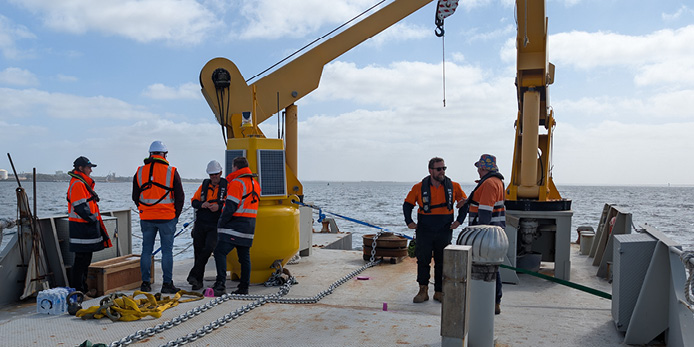
Two new IMOS Estuarine and Coastal Moorings will be deployed in Western Port Bay and Corio Bay, to establish a coordinated network of water quality observations across Australia’s coastal and estuarine environments.
Deployed by Deakin University, in collaboration with the Environment Protection Authority Victoria, Port of Hastings Corporation and Melbourne Water, the new moorings will provide near-real-time observations of key water quality parameters, including temperature, salinity, chlorophyll-a, dissolved oxygen and turbidity. The data will help build a consistent baseline for understanding changes in water quality and the pressures affecting coastal environments.
Western Port is a Ramsar-listed wetland of international importance and supports diverse ecosystems alongside significant commercial and development interests, including an operating port. Long-term water quality observations will provide an important evidence base for understanding environmental change and informing management in the region.
“Port of Hastings Corporation was proud to support the deployment of this monitoring buoy in Western Port in collaboration with Deakin University. Access to continuous, near-real-time water quality data enhances the Port’s ability to understand long-term environmental trends while assisting to inform climate-related risks in asset and operational planning at the Port.”
Port of Hastings Corporation
The Victorian sites are part of the national IMOS Estuarine and Coastal Moorings Facility, led by the South Australian Research and Development Institute (SARDI). The facility is establishing a coordinated network of moorings in shallow coastal and estuarine waters, providing standardised, near-real-time observations in environments where conditions can change rapidly.
The network measures core water quality variables across sites, with data integrated with existing IMOS observations and, where possible, information collected by state agencies, industry and other stakeholders. This coordinated approach is designed to improve spatial coverage and provide consistent data to support research, environmental management and decision-making.
The Victorian deployments follow the deployment of two new monitoring stations in Exmouth Gulf through State Government coinvested stations contributing to the network. Sites are also being established across Australia in other coastal regions as the national network expands.
The IMOS Estuarine and Coastal Moorings Facility is a key investment of the CoastRI initiative. Coastal Research Infrastructure, is a national initiative under Australia’s National Collaborative Research Infrastructure Strategy (NCRIS) coordinated across 13 NCRIS capabilities. It aims to establish a coordinated, national-scale coastal observing and modelling capability to address the challenges posed by rapid coastal changes.
“By supporting the IMOS Estuarine and Coastal Moorings Facility, CoastRI is enabling unprecedented access to high-quality, sustained water-quality observations. These data are essential for detecting changes in coastal and estuarine conditions, providing early warning of emerging water-quality issues, and supporting better management of the ecosystems and communities that depend on our dynamic coastal zone”
Professor Daniel Ierodiaconou, Lead Scientist for CoastRI