
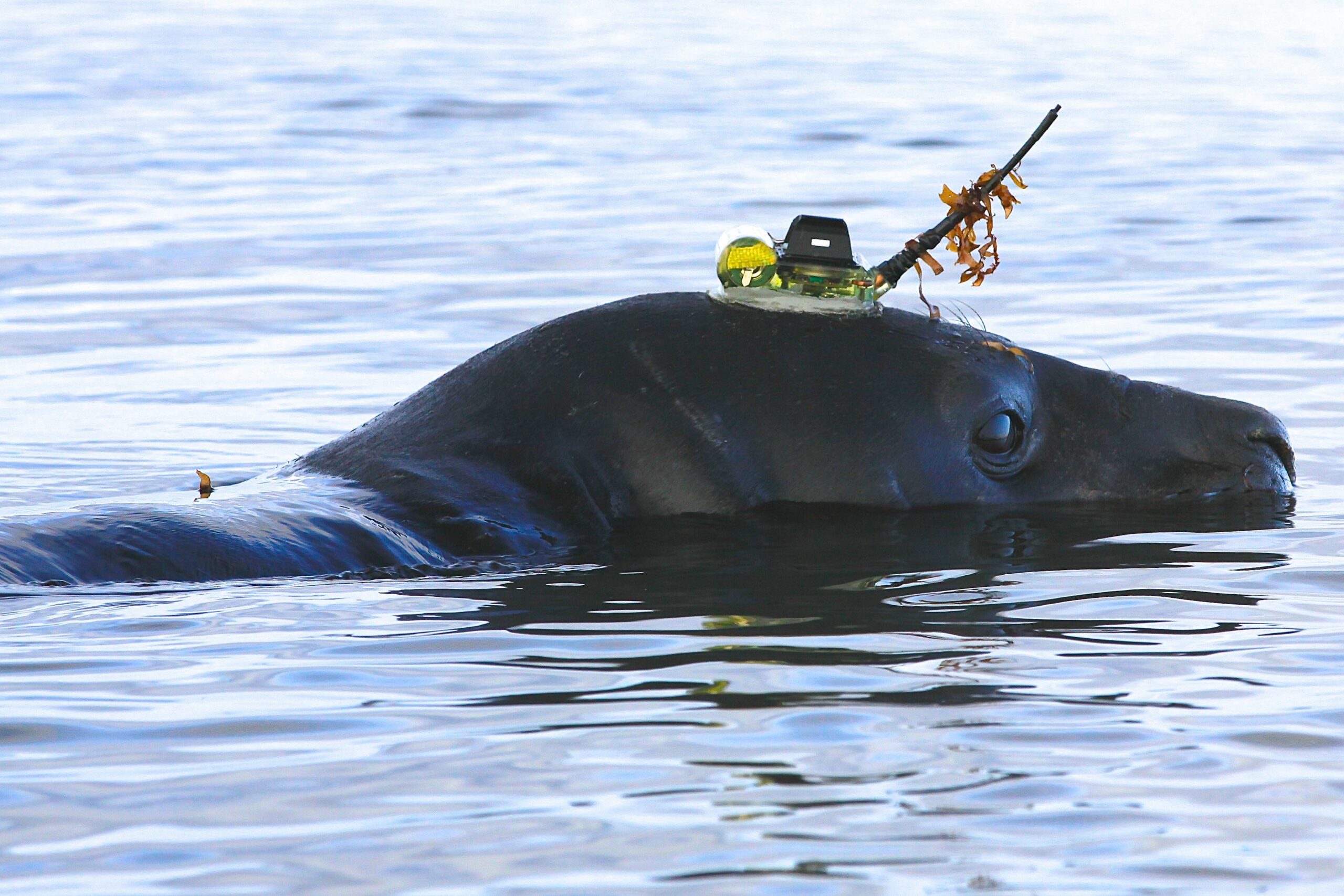
For two decades, the IMOS Animal Tagging Facility has equipped seals and sea turtles with ocean sensors to collect temperature, salinity and depth data from the Southern Ocean to the tropics. With more than 1,100 tagged animals generating over 440,000 ocean profiles filling major gaps in remote ocean observation.
These animal-borne sensors improve our understanding of marine megafauna ecology, climate processes, bathymetry, and ocean structure, offering cost-effective opportunities to strengthen long-term ocean monitoring, cyclone forecasting and climate resilience across Australia’s marine estate.
The world’s ocean stores ~90% of the excess heat generated by anthropogenic global warming, making sustained ocean observations essential for understanding physical, biological and climate processes. By equipping wide-ranging, deep-diving marine predators the IMOS Animal Tagging Facility provides critical observations from remote and under-sampled regions, particularly the Australian Antarctic Territory and tropical northern Australia, complementing traditional observing networks.
IMOS has deployed 1,107 instrumented tags on a range of animals including: 800 southern elephant and 129 Weddell seals, 50 Australian sea lions, 32 Australian and New Zealand fur seals, and 70 olive ridley, 10 green and 16 flatback turtles.
Twenty years of sustained observations demonstrate the importance of long-term, continuous animal-borne data streams as a core component of Australia’s IMOS.
“Long-term, sustained data series are essential to interpreting how our natural world is responding to anthropogenic change. We are very proud that the IMOS Animal Tagging Facility has contributed to a global understanding of how our oceans are changing, and have helped filled critical observation gaps in our southern ocean and tropical seas.” Professor Rob Harcourt, IMOS Animal Tagging Facility Leader.
Marine animals as oceanographers: How it works
The IMOS Animal Tagging Facility, operated by the Sydney Institute of Marine Science, manage the tagging of seals in the Southern Ocean and turtles in tropical northern Australia.
Seals are safely fitted with miniaturised loggers under approved animal ethics protocols with a veterinarian in attendance. Tags are designed to detach naturally after approximately 10 months, typically during the seals’ annual moult when they shed their hair and outer layer of skin. Fieldwork at Iles Kerguelen, Macquarie Island and the Australian Antarctic Stations is supported by the Centre National de la Recherche Scientifique and L’OCEAN in France, National Institute of Water and Atmosphere (NIWA) in New Zealand and the Australian Antarctic Division.
With the turtles, miniaturised loggers are fitted to the hard upper shell under approved animal ethics protocols, with IMOS staff working closely with Traditional Owners (Tiwi Marine Rangers and the Crocodile Islands Rangers) and researchers at the Australian Institute for Marine Science. Tags are designed to detach naturally after approximately 10 months as turtles grow and shed the outer layers of their shell scutes.
For both seals and turtles the data is transmitted in near real-time using the Advanced Research and Global Observation Satellite (Argos) system and made freely available to the operational oceanographic and weather forecasting communities.
Why are these observations so important?
The integration of oceanography and marine mammal ecology advances our understanding of the world’s oceans and their top predators and improves our ability to predict how these species may respond to future climate change. Recent technological advancements also enable the collection of critical ocean data throughout the Antarctic winter – observations that were previously unavailable but are essential for oceanographic and climate research.
Attaching sensors to sea turtles provides a cost-effective solution to a critical gap in tropical cyclone forecasting: the lack of sub-surface ocean observations in shallow seas. Tagged turtles are able to collect thousands of temperature profiles, revealing how storms cool the ocean through water column mixing, a key physical process that limits storm intensity, ultimately improving cyclone intensity forecasts to protect lives in vulnerable regions.
International collaboration
The IMOS Animal Tagging Facility team plays a key leadership role in the development and coordination of the global animal borne instrumentation observing network. IMOS Animal Tagging has been the lead agency in proposing and maintaining the Global Ocean Observing System (GOOS) animal-borne sensor (AniBOS) network. AniBOS was officially recognised as an Emerging Network within GOOS in 2020, recognising the essential role animal-borne observations play in GOOS. AniBOS has also won endorsement as a contributing project to the United Nations Decade of Ocean Science for Sustainable Development. IMOS Animal Tagging has contributed more than 420,000 sub-surface profiles, which represents nearly half of the 850,000 profiles, that AniBOS has provided to the global operation and research communities.
The IMOS Animal Tagging Facility works in collaboration with a number of international partners including the Centre National de la Recherche Scientifique, L’OCEAN and Système National d’Observation des Mammifères Échantillonneurs du Milieu Océanique (SNO-MEMO) in France, National Institute of Water and Atmosphere (NIWA) in New Zealand, the University of Gothenburg in Sweden, and the Sea Mammal Research Unit in UK.
New paper reviews 20 years of IMOS animal borne observations
To date, Animal Tagging data has been used to produce 283 publications, 33 projects, 50 policy documents and 44 presentations. IMOS Animal Tagging Facility has published a review in Marine and Freshwater Research as part of the IMOS special issue celebrating 20 years of transformative ocean science. The review outlines twenty years of sustained observations, and demonstrates the importance of long-term, continuous animal-borne data streams as a core component of Australia’s IMOS.
The IMOS Animal Tagging Facility have fostered strong international collaborations to deliver sustained animal-borne observations in some of the most inhospitable and under-sampled regions of the ocean, providing essential information during a period of rapid ocean change.
Read the IMOS Animal Tagging paper published in the Marine and Freshwater Research special issue here.
Header image: Clive McMahon, SIMS.
Data visualisations created by Fabrice Jaine, IMOS.