

Earlier this year, the National Mooring Network team has successfully retrieved the data from the instruments in the mooring array off Western Australia (WA).
An exceptional subsurface cooling event that occurred from early January to late March 2024, at 40-160 m depths (Figure 1, red box) was recorded by the instruments at the WATR20 mooring (200 m depth; Figure 2). This event was marked by temperatures as low as 12oC in January, at 200 m, with monthly averaged temperature anomalies being about 3°C cooler than climatology (Figure 1b, c).
These persistently low temperatures are unprecedented in the mooring observations on the Rottnest Shelf (Fig. 1b). Previous records of subsurface cooling of less than 2°C below average occurred during the summer peaks of the extreme 2015-16 El Niño and the weak 2018-19 El Niño.
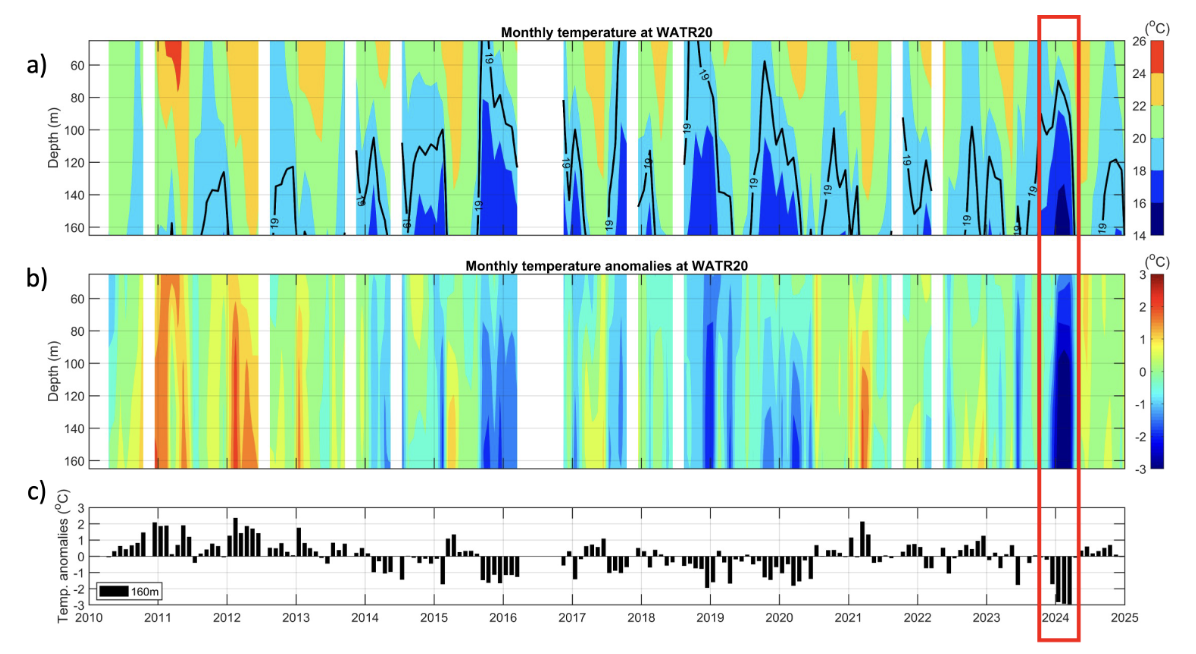
Figure 1: Temperature (top) and temperature anomalies (centre and bottom) recorded by the Western Australia WATR20 mooring between 2010 and 2025. The red box indicates the exceptional subsurface cooling event during the 2023/2024 summer.
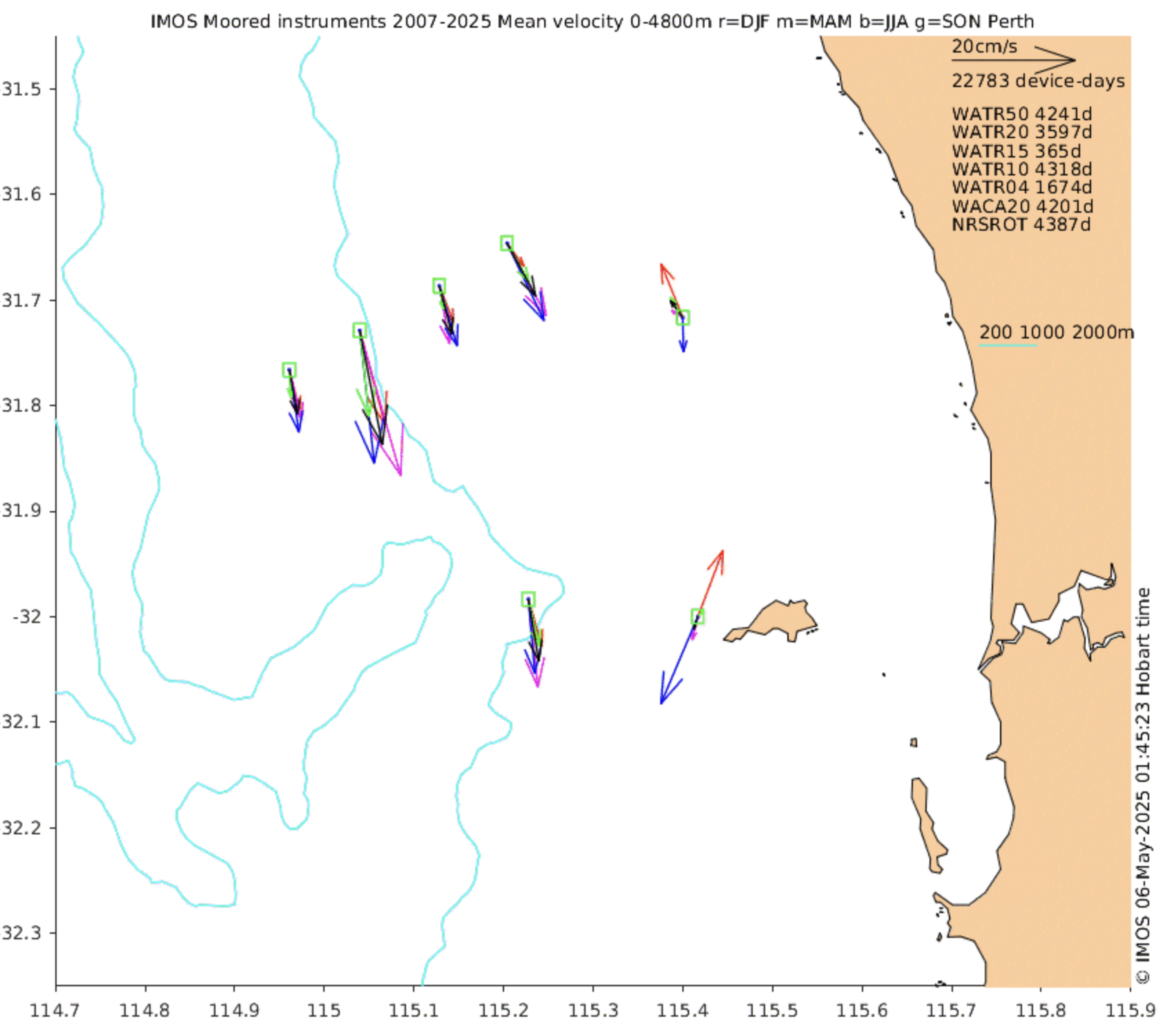
Figure 2: Location of the IMOS National Mooring array off Perth, with full-depth seasonal mean velocities (colours) over the full 2007-2025 record.
The 2024 subsurface cooling event was also sampled during a glider survey a bit farther north, off Two Rocks, from 26 to 30 January 2024 (fast forward from here, or click here for the entire glider track). The glider measurements from 27-29 January (Figure 3) show bottom waters cooler than 18oC encroaching upon the shelf, but not reaching the surface, and high values of chlorophyll-a concentration.
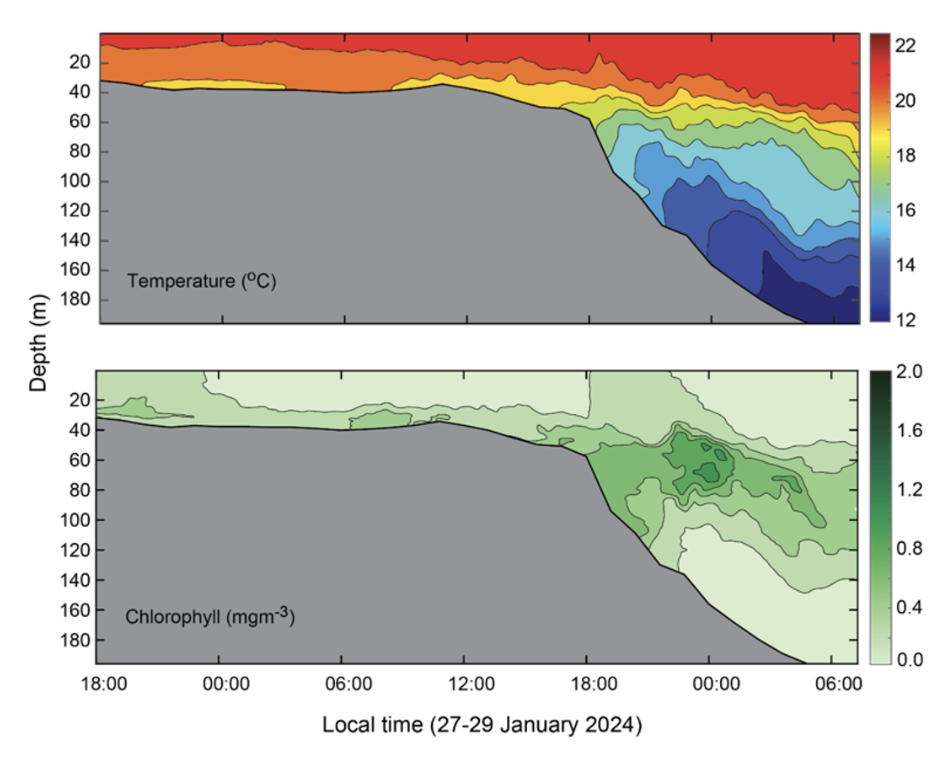
Figure 3: Temperature (top) and chlorophyll-a concentration (bottom) measured by an IMOS ocean glider off Two Rocks in 27-29 January 2024.
Despite the mooring measurements showing cold temperatures on the shelf for around three months, negative sea surface temperature anomalies off the southern WA coast were only seen in satellite data from 20/Jan to 18/Feb, peaking on 6th Feb. These conditions characterise a “cryptic” upwelling – an upwelling of cold bottom waters on the continental shelf that doesn’t fully reach the sea surface, being less visible from satellite data than from sub-surface measurements.
These subsurface measurements of a cryptic event show the importance of sustained moored observations and glider surveys to monitor marine extremes, especially in a region of high ecological value such as the southern coast of WA.
For now, we are unsure what caused this cold event at the mooring site.
The earlier 2015-2016 subsurface cooling seen in the mooring measurements was linked to a strong El Niño event. Usually, in El Niño years, strong westerly winds at the equator induce low sea level anomalies in the tropics that propagate to the WA coast, in the form of coastally trapped waves. Because of the propagation of these waves, the El Niño Southern Oscillation has been linked to sea level anomalies off Fremantle, WA (Feng et al., 2003). In El Niño years, the low sea level anomalies that arrive in WA are seen as an elevated thermocline and negative sea surface temperature anomalies.
However, the 2023-2024 El Niño was unusual, with no strong westerlies inducing the low sea level anomalies that propagate to the WA coast. So, at the moment, we cannot see a direct link between this exceptional subsurface cooling event and the 2023-2024 El Niño.
We know that regional air-sea interactions off WA can be significant at times. Therefore, the exceptional cooling in early 2024 could have been caused by a combination of regional ocean dynamics. This is still under investigation.
Written by Ming Feng, Toan Bui, Chari Pattiaratchi