
The main purpose of tide gauges is, of course, to measure sea level at the coast, for which there are many good reasons. Less well known is that gradients of sea level are also informative, just like gradients of atmospheric pressure. In the southern hemisphere, winds blow with high pressure on their left, at a speed proportional to the pressure gradient. This is called the geostrophic balance. Analogously, water flowing along the shelf is accompanied by coastal sea level higher on the left.
Satellite altimeters measure the sea level height in the open ocean. So combining this information with tide gauges along the coast is, in principal, a means of estimating coastal currents. We’ve just finished a study, using more than a thousand IMOS Acoustic Doppler Current Profilers (ADCPs, deployed across 61 locations over 18 years) to see how well this works in practice. The study used a new version DM03 of our Gridded Sea Level Anomaly product.
Our results are surprisingly good. The ADCP data showed that the ‘skill’ of geostrophic currents, defined (loosely) as 1-error/signal exceeds 0.7 at a few locations, and 0.5 at about 40% of locations. There are also some locations where the geostrophic currents have no usable skill on a daily basis, but statistics like the average magnitude, ratio of alongshore:across-shelf current variance, auto-correlation time-scale etc, are about right. FFI see more information including explanation of what is shown in the example graphics shown here.
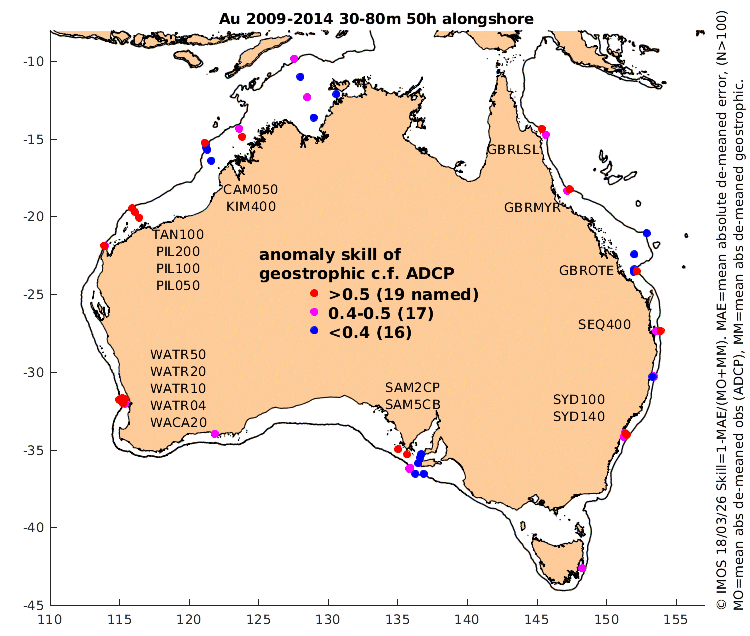
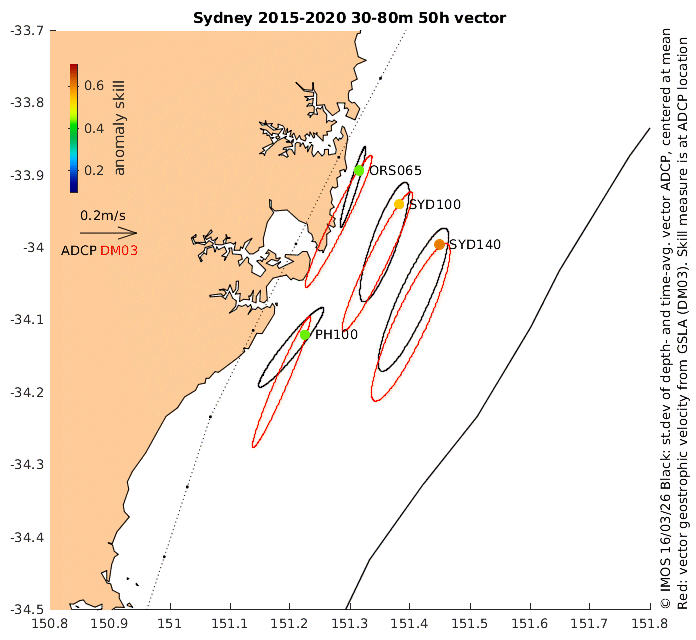
Consequently, we now know how much confidence can be placed in the geostrophic estimates, the beauty of which is that they span the entire Australian coast, for the last 30 years, at daily resolution. This is useful if your application needs estimates of currents for a specific time, a time period, or a region where there are insufficient direct observations, and you don’t have access to a validated ocean model. You might need a long record of estimates in order to calculate some sort of probability (of high or low speeds, north or south direction, for example).
Written by David Griffin, Madeleine Cahill, and Gabriela S. Pilo