
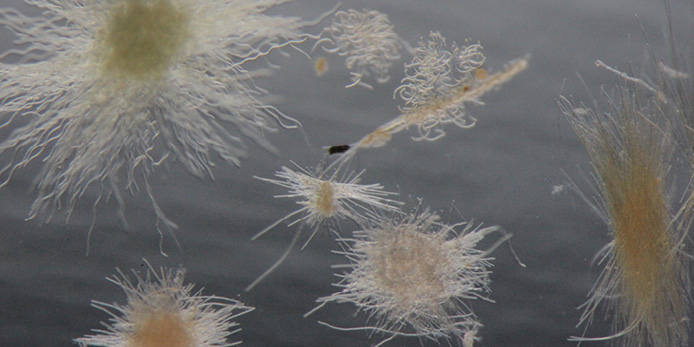
Long-term observations collected through the IMOS National Reference Stations (NRS) Facility are helping researchers uncover changes in one of the ocean’s most important nitrogen-fixing organisms.
Trichodesmium is a filamentous cyanobacterium that converts nitrogen from the atmosphere into a form that can be used by other organisms. This makes it an important part of nutrient cycling, particularly in the nutrient-poor waters of tropical Australia.
Since 2009, the Facility has collected regular observations at seven long-term monitoring sites around Australia’s coastline. These observations provide a consistent record of changes in marine life and ocean conditions over time.
“The sustained, consistent IMOS long-term monitoring surveys, combining traditional taxonomy with modern molecular techniques, are now delivering the datasets capable of answering some long-standing questions around plankton dynamics.”
Claire Davies, Senior Scientist CSIRO
In a recent study led by CSIRO, Australia’s science agency, researchers combined NRS plankton samples with observations from the IMOS Australian Continuous Plankton Recorder (AusCPR), environmental DNA and other coastal observations. The different approaches provide complementary views of Trichodesmium, from detailed measurements at fixed NRS sites to observations across much larger areas of Australia’s coastline.
The study found that Trichodesmium abundance has increased in Australian waters since 2009, particularly in the Coral Sea region.
At the Yongala IMOS National Reference Station in the central Great Barrier Reef, abundances were consistently around an order of magnitude higher than at the North Stradbroke Island NRS further south. Sea surface temperature was the strongest environmental factor associated with Trichodesmium abundance, with higher abundances found in warmer water.
The study also used environmental DNA data to confirm that the two most common species of Trichodesmium have different distributions across Australia. Trichodesmium has been detected along the south coast and into Tasmania which has not been seen from satellite, Trichodesmium is distributed throughout the water column, although in much lower abundances than at the surface.
Why does it matter?
Trichodesmium plays an important role in the Great Barrier Reef by adding new nitrogen to otherwise nutrient-poor waters. Previous modelling has estimated that it contributes around 0.5 million tonnes of new nitrogen to the reef each year.
Changes in Trichodesmium abundance could therefore influence productivity and nutrient cycling across the reef. However, large blooms can reduce light available to other organisms and, under calm conditions, contribute to oxygen depletion as blooms decay.
Although the16-year record provides new insights, more research is needed to confidently attribute the observed increase to climate change. Continued observations will be important for understanding whether the trend persists as Australian waters warm.
The study demonstrates the value of maintaining long-term observing programs. By returning to the same locations year after year, and combining observations from different platforms, IMOS is helping researchers identify changes that would be difficult to see from individual surveys or snapshots in time.
Read the case study, published in the Marine and Freshwater Research IMOS special issue, here.