
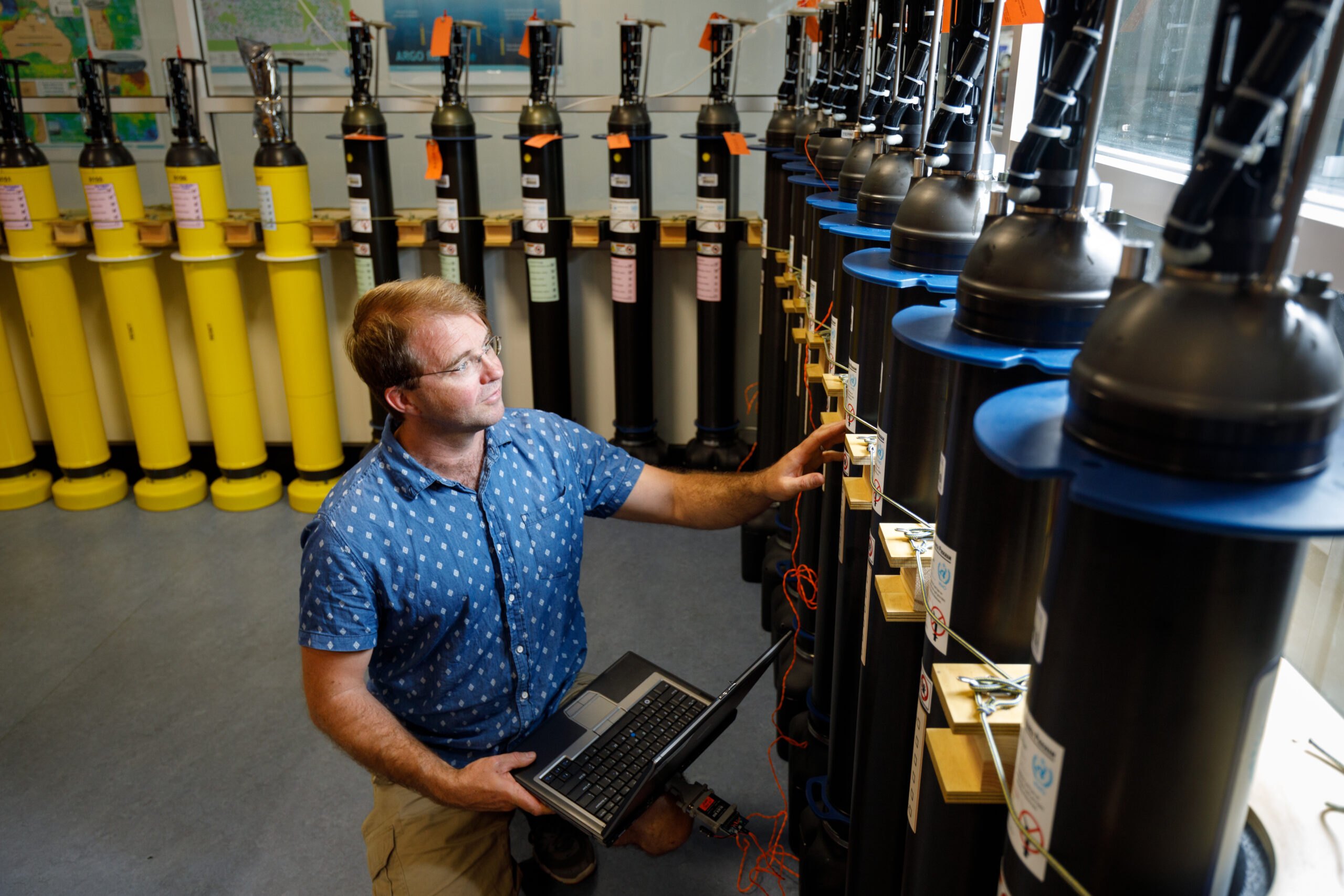
For more than two decades, autonomous Argo floats have been transforming our ability to observe the ocean beneath its surface.
Drifting through the upper ocean, Argo floats repeatedly profile from the surface to around 2,000 metres, measuring temperature, salinity and pressure before returning their observations by satellite. Biogeochemical Argo floats measure properties such as oxygen, pH, nitrate and chlorophyll in addition to temperature and salinity, while Deep Argo floats are extending observations to depths of 6,000 metres.
Together, these observations provide an unprecedented, sustained view of the ocean interior, supporting research, operational forecasting and climate monitoring.
More than 25 years of Australian Argo
The Argo float was one of the more established ocean observing technologies that formed Australia’s new Integrated Marine Observing System in 2006. The international Argo program brought with it nearly a decade’s worth of experience in technological development, operational experience in the oceans and well-established international links. Argo Australia was part of the international program from its inception as a founding partner. The program commenced with its first deployment in October 1999, with ten floats deployed by the end of 2000.
Today, Argo Australia manages around 7.5% of the global Argo array, with most Australian-managed floats operating in waters around Australia and throughout the Southern Ocean. As of December 2025, the program was managing 301 operational floats and had deployed a total of 1,230 profiling floats. Together, these floats have collected, processed and disseminated more than 285,000 profiles of ocean properties.
Argo Australia operates as a national partnership. Funded primarily by IMOS, Argo Australia is operationally led by CSIRO, Australia’s national science agency, and delivered in partnership with the Bureau of Meteorology, the University of Tasmania (UTAS), the Australian Department of Defence, and the Australian Antarctic Program Partnership (AAPP).
Australia’s climate, economy and environment are profoundly influenced by the surrounding oceans. From El Niño and La Niña to long-term ocean warming and sea-level rise, understanding changes beneath the ocean surface is critical for improving forecasts, managing climate risks and supporting informed decision-making. Argo Australia provides the sustained observations needed to monitor these changes and better understand Australia’s changing climate.
CSIRO’s Dr Peter Oke, IMOS Facility Leader of Argo Australia, said Argo’s success demonstrates the value of sustained investment in ocean observing:
“Argo is one of the great success stories in global ocean observing, providing the long-term measurements needed to detect, monitor and understand climate change while supporting ocean forecasting, maritime operations and the blue economy. Sustained support from IMOS and the ongoing commitment of our partners have enabled Argo Australia to develop a world-leading capability that delivers benefits nationally and globally.”
From the Australian ocean to the global observing system
The ongoing investment in Argo, as well as a dedicated and skilled team at CSIRO, has resulted in Australian floats outperforming international benchmarks, returning more observations over longer lifetimes and delivering greater value from every deployment. Australian floats return around 230 profiles over around 6.5 years, compared with around 165 profiles over 4.5 years internationally. This strong performance reflects expertise across float preparation and testing, mission control, real-time data processing and delayed-mode quality control.
Australia has also played a significant leadership role within the international program. As of January 2026, Australian Argo scientists were serving on the international Executive and Steering teams, Data Management Team, and the Polar, Biogeochemical and Deep Argo Mission Teams. Australian scientists have also previously chaired the international Argo Steering Team and Data Management Team, while Argo Australia initiated and leads the Argo Technical Community of Practice and Argo DMQC Discussion series.
Australia also provides support to other countries including New Zealand, India, China and South Africa, to help with various aspects of their national Argo programs.
Data that underpin decisions and discovery
Australia is one Argo floats have revolutionised our understanding of the broad-scale structure of the ocean. Since the Argo program began, the array of floats has provided more high-resolution ocean data than have ever been collected by traditional ship-based hydrography. Argo observations underpin hundreds of studies that have transformed understanding of the ocean’s role in weather, climate and marine ecosystems.
Argo Australia’s research has contributed to five major areas of scientific impact: ocean warming and the global freshwater cycle, eddy dynamics, processes under ice, abyssal change and Southern Ocean biogeochemistry. Argo observations provide direct evidence of changes in ocean temperature and salinity, while floats routinely sample ocean eddies and can reveal their physical and biogeochemical properties. In the Southern Ocean and Antarctic, observations from floats operating beneath sea ice and at depth are providing new insights into water masses, circulation and deep-ocean change.
Argo data contributes to Australia’s climate and weather forecasting through the provision of observations that contribute to Bluelink, a platform developed between CSIRO, the Bureau of Meteorology and the Department of Defence, used to model the dynamic and sparsely observed ocean.
Deep and Biogeochemical (BCG) Argo: extending the reach of ocean observing
Recognising the urgent need for more complete sampling of the deeper part of the ocean, the international Argo community has developed Deep Argo floats that can reliably measure temperature and salinity to depths of 6 km.
The sustained measurements provided by Deep Argo floats are opening new opportunities to quantify and understand changes in the deep ocean. Deep Argo provides crucial measurements for tracking changes in ocean heat content, salinity, sea level rise and deep circulation.
Since 2019, 17 Deep Argo floats have been deployed in the Australian Antarctic Basin. These observations have already more than tripled the number of deep profiles previously available in the region and increased winter observations tenfold. They are providing new insights into Antarctic Bottom Water and rapid changes occurring in the deep ocean.
One float travelled approximately 300 kilometres beneath sea ice and Antarctic ice shelves, returning almost 200 full-depth temperature and salinity profiles. The observations revealed differences in the water masses beneath the Denman and Shackleton ice shelves, providing evidence of how ocean circulation can influence ice-shelf melting.
Argo Australia has undertaken extensive research using BGC Argo observations, particularly in the Southern Ocean. These observations have been used to investigate eddy-driven biogeochemical variability, quantify net community production and phytoplankton dynamics, and examine the effects of atmospheric inputs such as wildfire aerosols and dust on ocean biogeochemistry.
The value of sustained research infrastructure
Argo Australia illustrates the value of sustained research infrastructure: observations collected year after year become increasingly powerful as they build a long-term record of change.
As IMOS celebrates 20 years of sustained ocean observing, Argo demonstrates what can be achieved through long-term investment in infrastructure, expertise and partnerships. Its observations are now embedded in Australian and international research, forecasting and climate applications.
The Argo program has transformed our ability to observe the physical and biogeochemical state of the global ocean, providing truly global, full-depth and multi-disciplinary coverage. Australia’s contribution extends beyond maintaining floats: through research, technical expertise, data management and international leadership, Argo Australia is helping turn sustained observations into scientific understanding and practical capability.
To date, Argo Australia data has been used to produce 996 publications, 72 projects, 174 policy documents and 208 presentations. IMOS Argo Australia Facility has published a review in Marine and Freshwater Research as part of the IMOS special issue celebrating 20 years of transformative ocean science. The review describes the structure, operations, performance and impacts of Argo Australia, highlighting how the program supports the global Argo array and delivers value to Australian and international users.
Read the IMOS Argo Australia Facility paper published in the Marine and Freshwater Research special issue here.
Header image: CSIRO.
Data visualisation created by Fabrice Jaine, IMOS.