
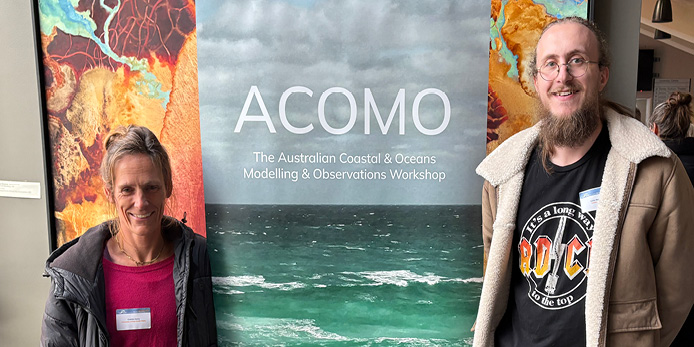
More than 80 people from academia, operational agencies, government and industry gathered in nipaluna / Hobart last week for the 2026 Australian Coastal and Oceans Modelling and Observations (ACOMO) Workshop.
Hosted by IMOS, ACOMO provides a national forum for the ocean modelling and observing community to share research, strengthen collaborations and identify opportunities to better connect observations with forecasting and decision-making.
Held over three days at the University of Tasmania, the workshop showcased the latest developments in coastal and ocean science, with presentations spanning satellite observations, ocean forecasting, marine heatwaves, sea level rise, reef restoration, harmful algal blooms, fisheries, tropical cyclones and emerging artificial intelligence applications.
The event brings together ocean modellers and ocean observers, and facilitated the collaborations that result in improving models and forecasts. The program highlighted the critical role that sustained ocean observations play in informing ocean models and managing our marine estate.
Keynote presentations examined the substantial untapped potential within existing ocean observations and the opportunities to enhance the value of current and future observing efforts, the growing role of new technologies such as micro-ROVs in reef and coastal science, and how artificial intelligence and machine learning are reshaping prediction systems.
Across seven sessions, researchers presented new approaches to understanding Australia’s coastal and marine environments, including improvements to forecasting in the East Australian Current, high-resolution modelling of the Great Barrier Reef and Tasmania’s Macquarie Harbour, sea-level projections for Australian coastlines, and the use of machine learning to improve satellite observations and climate projections.
Supporting the next generation of marine scientists was a key focus with an Early Career Researcher networking mixer providing opportunities for emerging researchers to share their work and build new collaborations.
The workshop also included discussions on Observations and Modelling for extreme events and the role of AI and Machine Learning in ocean modelling.
Thank you to our presenters, and all who attended.
Thank you to IMBROS for sponsoring the workshop dinner.