
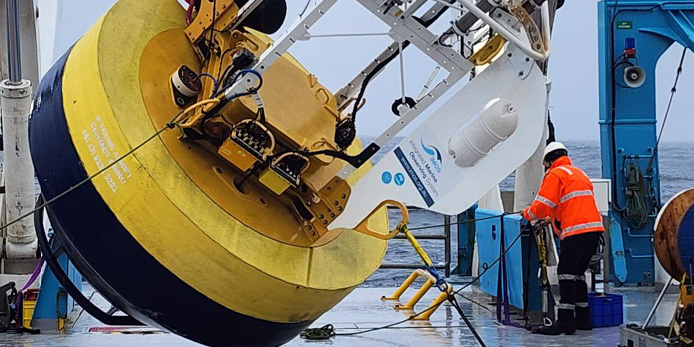
IMOS provides a crucial baseline to track climate change with moorings in the remote and extreme environment of the Southern Ocean.
The IMOS Southern Ocean Time Series (SOTS) observatory moorings are deployed approximately 500 kilometres southwest of Tasmania in the sub-Antarctic Zone (140°E, 47°S), one of the most remote and storm-lashed regions on Earth. This critical observatory provides year-round, high-frequency data in a region responsible for ~40% of the total global ocean uptake of human-induced CO2 emissions, and 75% of the additional heat that these emissions have trapped on Earth.
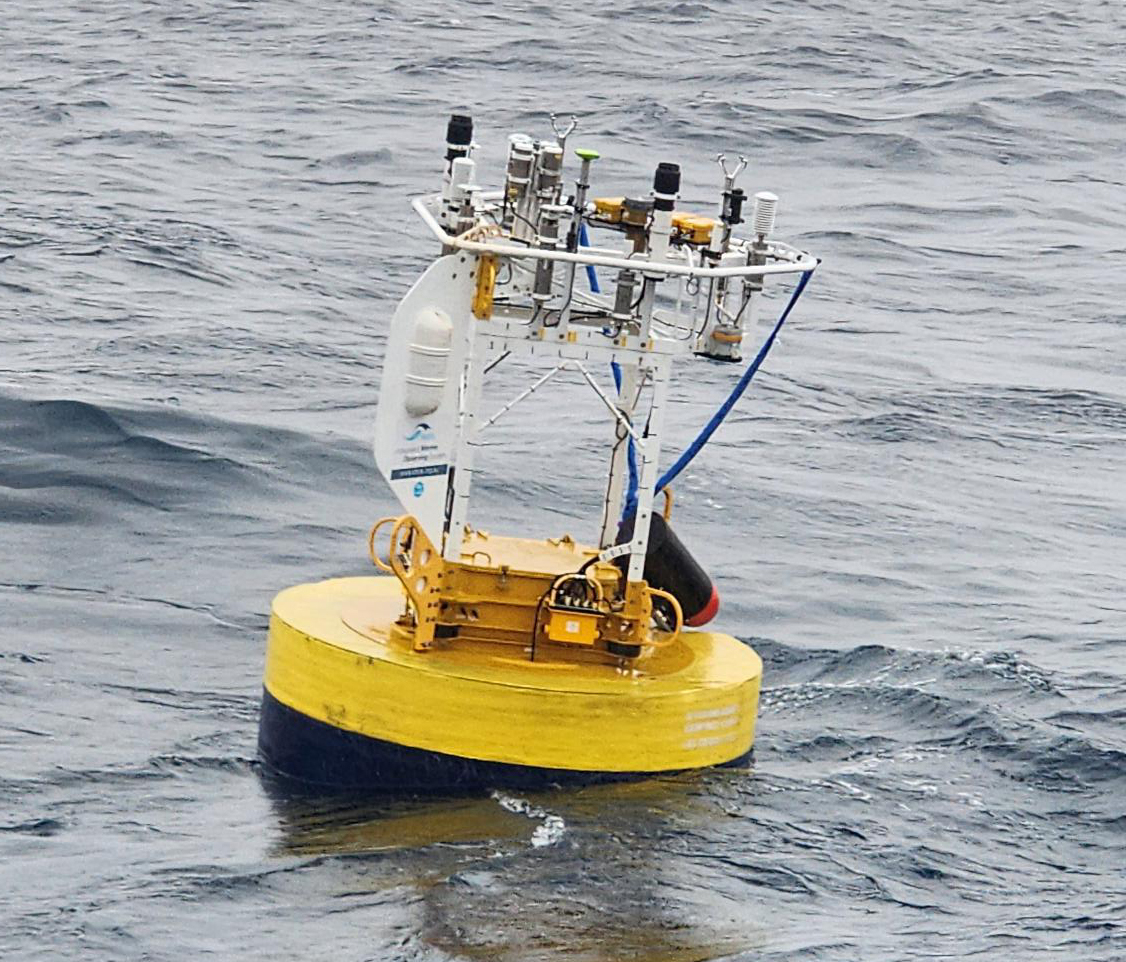
The Southern Ocean Time Series observatory comprises two deep-water moorings: the Southern Ocean Flux Station (SOFS), which focuses on heat, oxygen, and CO2 fluxes across the air–sea interface as well as the physical conditions and biological processes that control them, and the Subantarctic Zone (SAZ) sediment trap mooring, which focuses on quantifying the transfer of carbon to the ocean interior by sinking particles, providing samples for ecological, palaeo-proxy, and carbon flux estimates.
The Southern Ocean Time Series observatory provides crucial data in this under-sampled region to monitor for climate change, ocean acidification, and biological carbon cycling.
The SOTS programme is part of the OceanSITES global network of fixed time-series stations and contributes data to the Global Carbon Project and the Surface Ocean Carbon Atlas (SOCAT).
IMOS can only deploy these moorings in this remote location through a collaboration with Australia’s national science agency, CSIRO, the Bureau of Meteorology, and the Australian Antarctic Program Partnership.
Each year the team travel south on CSIRO research vessel (RV) Investigator to retrieve the deep water mooring after deploying a replacement — a complicated task that, in rough conditions, is no easy feat.
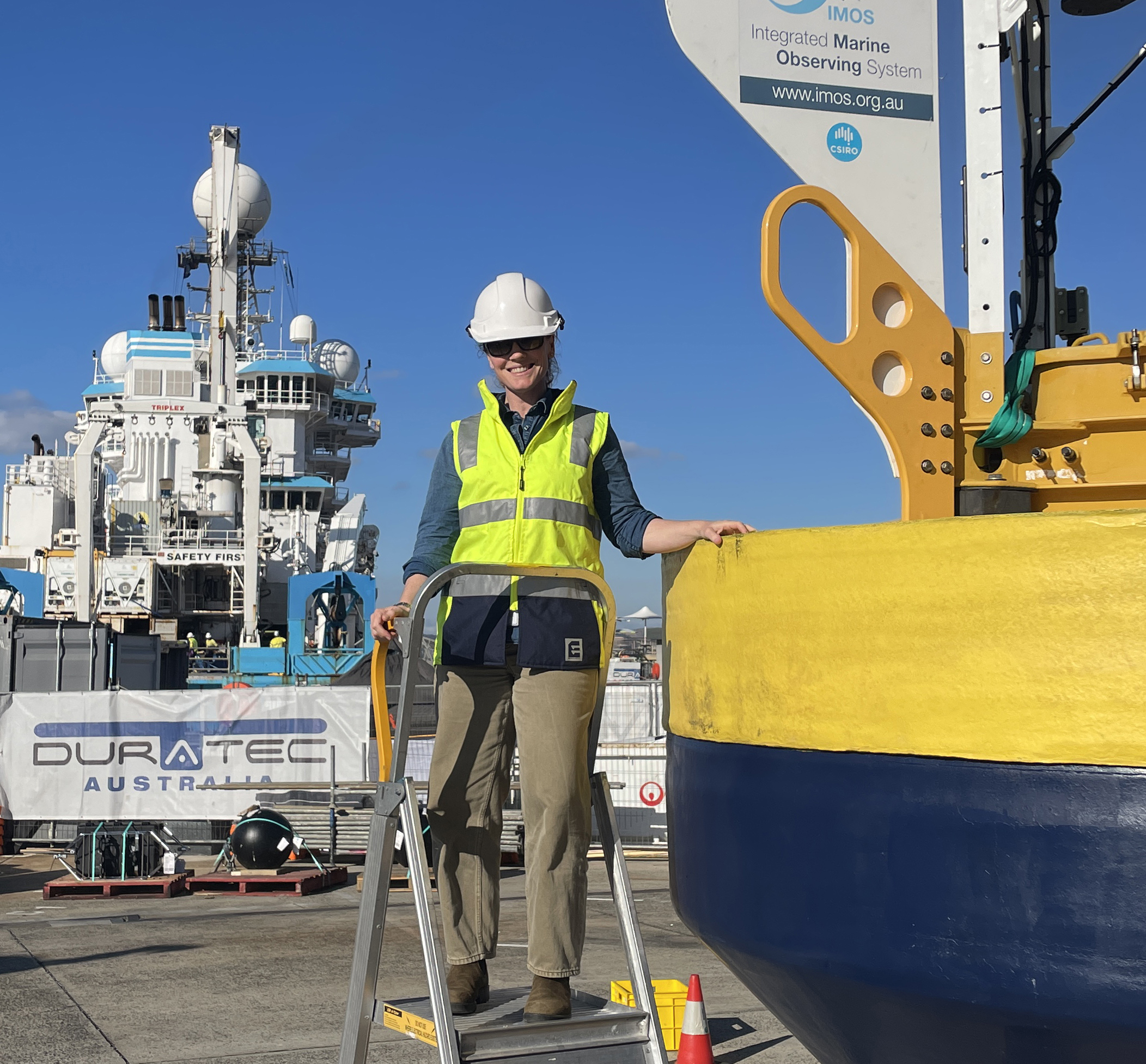
Dr Elizabeth Shadwick, IMOS Facility Leader and CSIRO Principal Research Scientist, describes the SOFS mooring as an observatory which is anchored to the seafloor.
“There is an anchor made up of a stack of train wheels, which weighs about 3000 kilograms, and then lots of line which runs to the surface. A big float, that’s about the size of a car, sits on the ocean surface and is heavily instrumented with sensors, which allow us to make measurements of the atmosphere as well as the ocean. Under that is wire which contains a further set of instruments that allow us to observe the properties of the subsurface ocean.”
Dr Elizabeth Shadwick
To date, Southern Ocean Time Series data has been used to produce 306 publications, 27 projects, 46 policy documents and 49 presentations. Two recent papers highlight the importance of sustained observations at the site.
Dr Shadwick is the lead author on a paper that used observations collected at the SOTS site between 1997 and 2022, to present the seasonal variability in upper-ocean hydrography, biogeochemistry, phytoplankton and microplankton community composition, and diversity, along with particulate organic and particulate inorganic carbon export to the deep ocean.
This climatological view of the region is complemented by a review of recent findings underpinned by observations collected by the SOTS observatory and highlighting the ongoing need for long time series to better understand the Subantarctic Ocean and its response to a changing climate.
The paper concluded that by continuing the observational records acquired at the SOTS site, the progress of ocean acidification, deoxygenation, and availability of iron and other nutrients as inputs to broader assessments of expected changes in marine ecosystems can be made. Improved understanding of the mechanisms controlling heat and carbon uptake by the ocean will be used to improve their representation in models and forecasts, which are the tools needed to provide advice about climate variability and its likely future impacts on biogeochemical cycles and marine ecosystems.
Dr Haifeng Zhang and Dr Eric Schulz, researchers at the Bureau of Meteorology, have also published a paper that examines over 13 years of data from 12 Southern Ocean Flux Station (SOFS) mooring deployments to explore the characteristics and temporal climatology of air–sea heat flux in the Southern Ocean.
Over the study period, the average annual net heat flux at the SOFS site is −14.6 ± 5.4 W m−2 – a net ocean heat gain. This is the first estimate of the net heat exchange at a Southern Ocean site that is based on a multi-year record of high-quality measurements, offering direct evidence of the ocean region’s absorption of heat.
Additionally, a case study highlights a strong horizontal sea surface temperature gradient (3.4°C over 35.5 km) that resulted in a significant net heat flux difference of up to 242.5 W m−2, which showed that the environmental conditions in this region may shift dramatically over short temporal or spatial scales.
IMOS has sustained the longest time series of Southern Ocean observations operated by any nation, contributing to the global effort to understand ocean dynamics and their role in climate and responses to anthropogenic emissions.
On a recent episode of the ConnectSci podcast, Dr Elizabeth Shadwick discusses the long-running Southern Ocean Time Series south of Tasmania, a deep-ocean observatory revealing how the ocean absorbs and stores heat and carbon.
The IMOS Southern Ocean Time Series is supported by multi-year grants of sea time on RV Investigator from the CSIRO Marine National Facility.
The CSIRO Marine National Facility is supported by the National Collaborative Research Infrastructure Strategy (NCRIS).
Feature image: CSIRO, Rod Palmer