
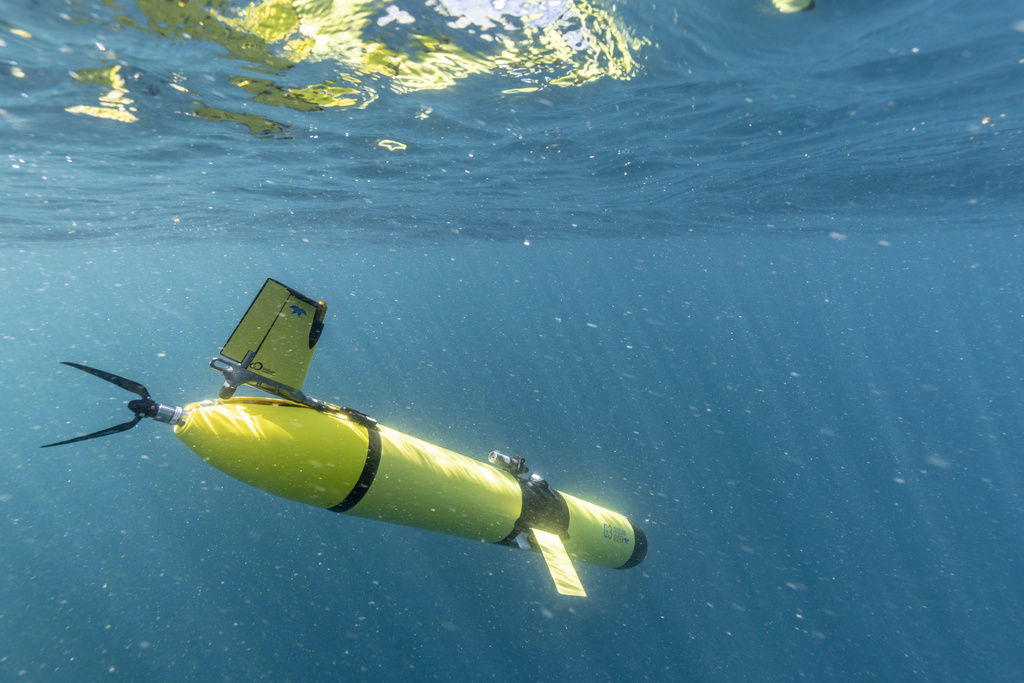
As IMOS continues to celebrate its 20th anniversary, a new behind-the-scenes video highlights the people and processes that make the IMOS Ocean Glider Facility possible. The Facility has launched the video to celebrate the opening of the International Underwater Glider Conference, hosted this week at The University of Western Australia (UWA) Oceans Institute. The Conference brings together 80 participants from 24 countries.
Ocean gliders operate autonomously beneath the waves, but every deployment begins long before a glider enters the water. From planning and laboratory preparation to deployment, piloting, recovery and data delivery, each deployment is the result of weeks of careful coordination by technicians, engineers, scientists and field staff.
On each deployment, a glider will travel hundreds of kilometres repeatedly diving through the water column, collecting high-resolution observations of Australia’s changing marine environment. They measure temperature, salinity, dissolved oxygen, chlorophyll, ocean currents and other Essential Ocean Variables, providing the data that underpins marine research, weather and ocean forecasting, and environmental management.
“IMOS ocean glider deployments have been a remarkable success, delivering sustained, high-quality observations of Australia’s ocean environment and transforming our ability to discover and monitor ocean processes, understand their variability, and detect change. This is due to a team of very passionate, enthusiastic group individuals with a great passion for the ocean.”
Professor Chari Pattiaratchi, Professor of Coastal Oceanography at UWA and Facility Leader, IMOS Ocean Gliders.
The video follows the complete lifecycle of a glider, highlighting the often-unseen work that ensures every deployment is safe, every instrument is performing at its best, and every dataset meets rigorous quality standards before being made freely available through the IMOS Australian Ocean Data Network (AODN) Portal.
Over the past two decades, the IMOS Ocean Gliders Facility operated at the University of Western Australia, has become an important part of Australia’s Integrated Marine Observing System enabled through the National Collaborative Research Infrastructure Strategy (NCRIS). To date, the Facility has completed more than 450 deployments, spent over 10,400 days at sea – the equivalent of more than 28 years continuously in the water, travelled more than 230,000 kilometres, and recorded over 1.5 million vertical profiles.
To date, glider data has contributed to 233 scientific publications, 54 research projects and 39 postgraduate research projects, supporting advances in ocean science both in Australia and internationally. The research has been particularly influential in ocean health and resource management, climate change, and variability and extremes. Glider-enabled research has also informed 55 policy documents.
These observations have supported research into Australia’s marine environment, from uncovering dense shelf water cascades and monitoring marine heatwaves to enabling event-based deployments that capture extreme events such as tropical cyclones, harmful algal blooms and river plumes as they unfold.
These achievements wouldn’t be possible without the dedicated teams working behind the scenes. Whether preparing gliders in the lab, coordinating complex logistics, monitoring deployments from shore or processing data after recovery, their expertise ensures researchers, governments and industry have access to trusted, high-quality ocean observations.
Header image: Nick Thake